
Boats, Boats, and Bigger Boats
Maritime Transport and Warships in the Ancient World
The ancient world in the Mediterranean was surrounded by water yet not all civilizations were seafaring in the beginning. Each civilization did not have the same uses for maritime transport; the Greeks and Romans, for instance, often used their ships for war. The Egyptians used their ships to travel up and down the Nile. And the Phoenicians used their ships for both trade and war. The study of ancient vessels can be very tough to interpret from primary source documents since the term warship (“Triērēs”) was used for many vessels that had “three banks of oars,” and interpreting what ships were being described is quite difficult. Throughout this article, I will examine the most popular ships from each of the major civilizations of the ancient Mediterranean world.
The “Warship”
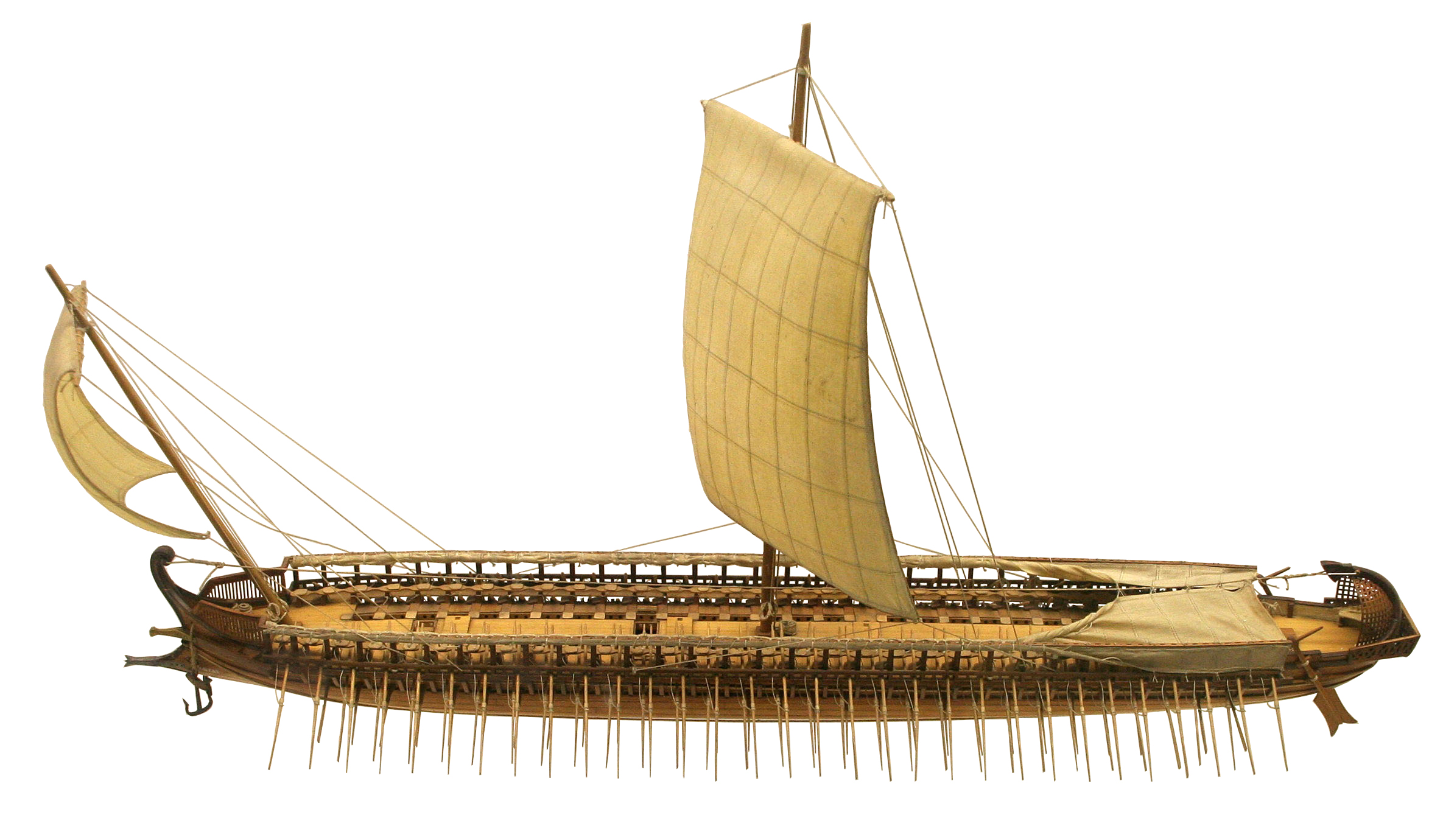

Out of all the ships discussed here, the Trireme is probably the most recognizable from the ancient world. With its three layers of oars and its bronze-plated prow, the Trireme was a staple of the ancient Greek navy. The exact date of introduction of this ship is unknown but it is accepted that it was around 700 BC and the country of origin is debated among modern scholars. It is assumed that this ship is a descendant of the Bireme which was a smaller war vessel used by the Greeks and Phoenicians, and later the Romans. The Greek introduction of the Trireme is credited to Corinth, which was an ancient Greek city-state known for its wide ranging trade networks, and specifically a shipwright named Aminocles (Davison 1947). Aminocles built 4 of these ships for the Samians, and then Corinth introduced these larger vessels to the Athenians, which would then become a staple of the Athenian fleet. This large new war vessel allowed the Athenians to then rule the waters of the eastern Mediterranean for the next century.
Triremes were used in a few battles in the 6th century BC, though this lack of knowledge is partially due to primary sources not being specific about the exact ships being used in battle. So, it is likely that they were far more prevalent. But in 525 BC, Herodotus is explicit in his description of the ships used in the Battle of Pelusium (“Herodotus, The Histories, Book 3, Chapter 44, Section 2” n.d.). He mentions that 40 Triremes were sent by island of Samos to help the Persians invade Egypt.
The Trireme was designed to maximize all of its strengths, to the point that it was so light that any less weight might have crippled the strength of the vessel. The placement of the oars and sails was to maximize speed along with the reduction of weight. The design of the ship allowed for the center of gravity of the vessel to be at its lowest point which helped to prevent rollovers, both on impact and in high swells. The use of very light wood did have disadvantages, like the affinity to becoming waterlogged, which required the boats to be removed from the water at night. The removal of boats from the water made fleets of Triremes susceptible to surprise attacks. Naval battles entailed ramming and boarding of your adversaries, which is why Triremes had reinforced rams on the front. The Trireme contained roughly 200 crew members on board, 170 of which were rowers, along with a deck crew and collection of Marines (Thucydides 1998, bk. VII.29). The crews were not always composed of slaves; instead the crew aboard triremes were often composed of free men from the lower classes. If slaves were aboard the ship they often were given their freedom after their deployment (Graham 1992).
Surprisingly, the Athenian populace disliked its Navy during the 5th century BC. Soldiers who were sent to sea were viewed as lesser men compared to those deployed on land (Butera 2010, 111–16). Yet the Athenian navy was feared in the Mediterranean among both its allies and enemies. The trireme was the flagship of the Athenian navy and among the many navies of ancient antiquity, the trireme is often associated with the Greeks. The Athenians had a navy of between 200-300 triremes at any given time (Butera 2010, 74). By the 5th and 4th century BC, most of the principal civilizations had navies of some form, the navies of the Greek city states often being some of the strongest, especially the Athenian navy. Even though the people of Athens might not have fully appreciated the navy, the trireme protected their many aquatic borders. The Trireme was the cornerstone of the Greek navy for hundreds of years, but eventually, they wanted to make their warships even larger. If you want to learn more about these larger warships you can find more information here.
Rome and its Raven


Unlike Greece, Rome did not have naval experience until the 3rd century BC. Until then Rome had no need to go to war at sea, instead, they strategically chose their allies so that they at least had the possibility of providing naval support. One of these allies was Carthage, who controlled the western waterways of the Mediterranean. Looking at figure 2 you can see Carthage and Rome’s control during the early 3rd century. Things did quickly change as Sicily, which was known for its fertile lands, became a point of tension between the two allies. Sicily was controlled by Carthage except for a small independent Greek kingdom called Syracuse. Carthage for years had been encroaching on Syracuse’s territory which also caused Carthage to approach Roman territory. Syracuse was able to convince Rome to join them as an ally to fight against Carthage. At first, the fighting for the Romans on Sicily was on land since that was the only method by which the Romans knew how to fight. But because most of the major cities of Sicily bordered the ocean, the Romans struggled to defeat the Carthaginians since they lacked a navy.
The first Punic War forced Rome to build its navy. Rome was lucky enough to capture a wrecked Carthaginian quinquereme, on which they based their first ships off. Roman ship makers were able to make 100 quinqueremes along with 20 triremes (Tarn 1907). These ships weren’t exact copies; for instance, they were not designed as well as the originals, and as a result they did not travel as fast. But they did have a new feature that set them apart from the original, the so-called Corvus (Latin for raven). The exact inventor of the Corvus is unknown, possibly invented by Archimedes, but it was outfitted on most ships in the Roman fleet.
The Corvus, as seen in figure 3, was a boarding device affixed to the front of the vessel. The Corvus would drop down and stick its spike onto an enemy ship. A squadron of Roman marines would then board the enemy ship taking it over. Rome had a very formidable land army so instead of retraining soldiers so that they could fight naval battles the traditional way they simply brought land battles to sea (Lazenby 1996, 68–72). The first large naval battle that the Romans fought during the Punic War, the Battle of Mylae, had the Corvus see combat for the first time. This new development caught the Carthaginians off guard and allowed the Romans to capture 30 ships and win the battle sending the enemy fleeing.

The Corvus was a way for the Romans to put their own twist on naval battles. They were able to add their identity as being a strong land force into their introduction into the nautical realm. It is still debated but the Romans likely made their ships slow and heavy on purpose so that the enemy would come to them so that they could board them (Lazenby 1996, 70). And unlike traditional methods of naval battles, the ships captured by the Romans could be reused which allowed them to grow their navy. In the years to follow, Rome grew its navy taking advantage of the technological improvements of the time. The Corvus will always go down in history as a creative way to not retrain foot soldiers.
The Egyptians and Their Lumber Shortage
Like the Greeks and Romans, the ancient Egyptians eventually started using triremes for naval battles but unlike the members of the northern Mediterranean, Egypt had another body of water within their borders. The Egyptians had a special relationship with nautical travel, due to the Nile River. The Nile provided a unique challenge for the Egyptians given its width and conditions. Because of this, the Egyptians made special boats unique to Nile transport, but before we get to that, there was another issue the Egyptians faced that should be looked at first.
Not surprisingly, the Egyptians had little access to timber due to their location. The Nile River was fertile near its shores and at the delta, but up the Nile, access to timber was much more restricted. This resulted in a unique practice emerging, instead of people owning boats they would commission boats, which then would be made for the journey. The intriguing part of this setup is that, when they would return from their voyage, the boats would then be inspected for any damages accrued from the journey and then taken apart so that the wood could be used for other purposes along with the production of more boats (Ward 2010).
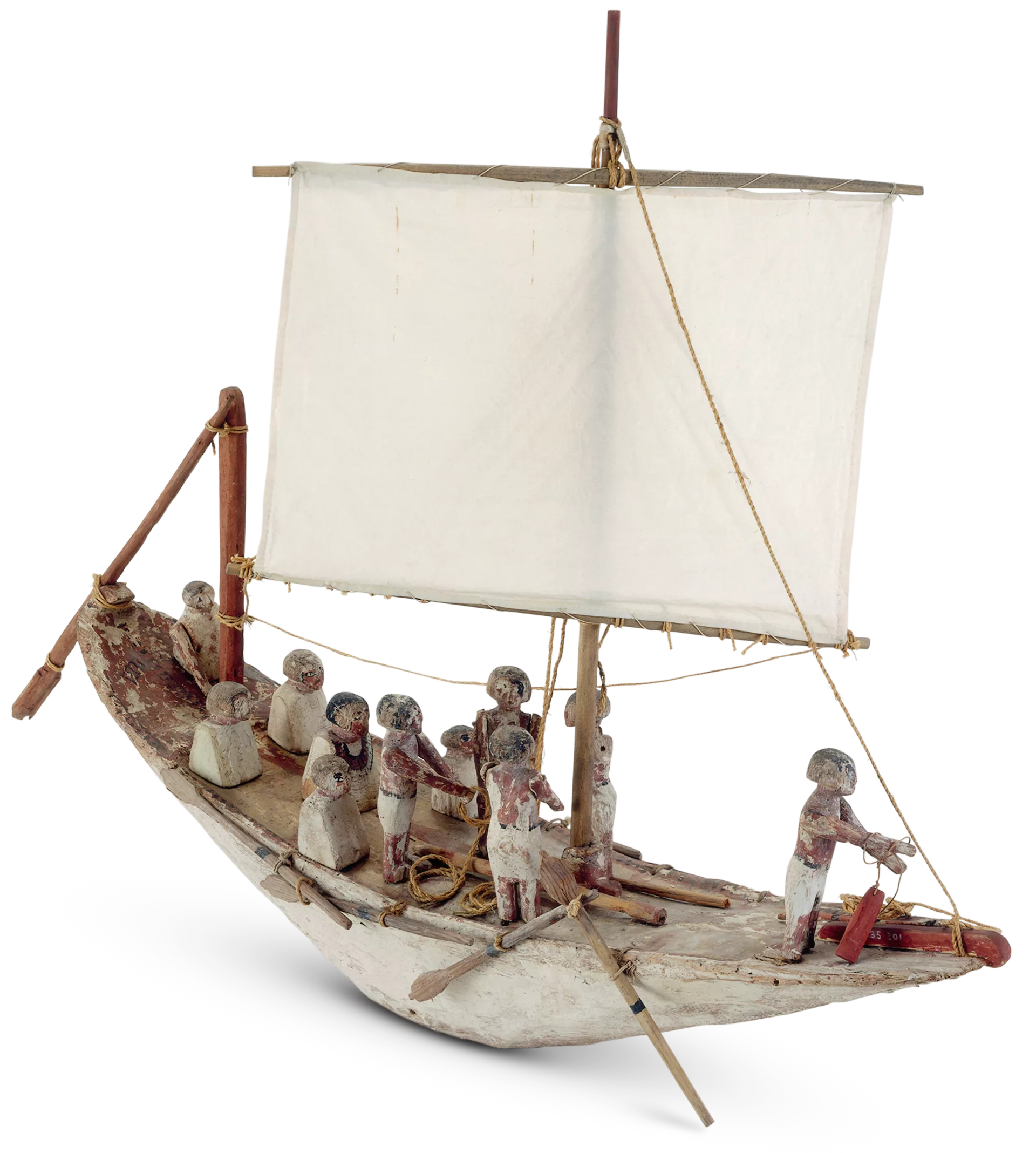
Originally the boats used on the Nile were small papyrus watercraft that only were used for small fishing trips and short journeys. But eventually, ships began to be made from wood, which allowed for larger ships to be produced, allowing for easier and longer travel. With the introduction of wood vessels and the sail, travel on the Nile increased drastically and became one of the main ways to travel in Egypt. Ships also began to separate into different specializations, like military use, transport and trade, and ceremonial use. The Nile was both a natural highway and a method for depositing fertile soils throughout the kingdom. This resulted in many religious practices being carried out on the Nile as it had both spiritual and economic importance (Vinson 2013).
Unlike the Greeks and Romans, who used a couple of different types of ships and specialized in their advantages, the Egyptians had many different boats. There isn’t one type of boat that sticks out in the ancient record as the most common. So instead, we will look at common features between the boats on record. Almost all the boats used on the Nile River are skinny and long with the bow and stern curving up out of the water (Vinson 2013; Ward 2010; Usai and Salvatori 2007). This can be seen in figure 4. One unique feature that is seen in ceremonial boats is a long upright post at the bow and a bent post at the stern. These design features were built to represent the ends of an old-fashioned papyrus boat, which symbolizes the gods which they believed appeared as papyrus (Vinson 2013, 2).
The Egyptians eventually left the Nile Delta and began to explore the Mediterranean, yet their boats did not change in design. The boats did increase in size, but the proportions of the vessel remained the same. This allowed Egyptian ships to become very identifiable in the Mediterranean. Ultimately the Egyptians adopted other styles of boats but for a period before and during the Ptolemaic era, Egypt’s nautical identity was very identifiable. In the modern era, these styles of boats are referred to as Felucca and more information can be found here.
The Cargo Ships of Antiquity
The Phoenicians were one of the most formidable seafaring people in the world of antiquity. The Phoenicians were primarily trading people and artisans, and farmers second. The Romans, Greeks, and Egyptians obtained most of their food from agriculture, whereas the Phoenician people sailed around the Mediterranean and traded their artisanal goods so that they could purchase other foodstuffs. To do this they would purchase raw materials and then produce goods from them, like metal vessels and jewelry. Out of all the major civilizations in the region, the Phoenicians were the best sailors which is likely one of the reasons that there have been very few wrecks of ships found (Cartwright n.d.).
Even though there have been few discoveries of Phoenician wrecks, there still have been records of their sailing vessels found in written works and through art. The Phoenicians were known for two types of vessels, the Bireme, and their trade vessels. The Bireme was the precursor for the Trireme and was mostly a smaller version with two sets of oars rather than three. On the other hand, they also had trading vessels that were larger with thick and wide hulls so that they were more structurally sound along with being able to carry large amounts of cargo (Cartwright n.d.). The trading vessels had an estimated capacity of 450 tons per ship which is a lot on its own but to maximize trade routes the Phoenicians would travel in fleets of up to 50 ships. This is the equivalent of 1/7 the size of the largest cargo ships today in trading capacity (“Container Ship” 2022). This might not seem like a lot but think about the technological advances that have occurred over the past 3000 years which have allowed for trade capacity to increase by seven-fold. The Phoenicians had the organization to run a trade empire both throughout the Mediterranean and especially the African coast.


Perhaps more-so than any of the other civilizations looked at in this article the Phoenicians were primarily a sea-faring people, setting up many trade outposts along the African and European coasts. They were able to do this because they did not try to colonize the people around their settlements. Instead, they entered trade relationships with them which allowed the Phoenician people and the locals to benefit from the situation (van Alfen 2015). The Phoenicians’ identity was tied to their sailing vessels, which resulted in their nautical abilities and their vessels being used by many different civilizations. Xerxes the Great, a Persian king, is recorded saying that whenever he had to travel he required that it be on a Phoenician ship (Cartwright n.d.).
Conclusion
The people of the Mediterranean valued the sea and relied on it for protection, trade, and travel. The Greeks and Romans used it to assert their dominance over the many nations of the time. The Egyptians used both the Nile and the Mediterranean to travel and trade, along with holding religious ceremonies on the water. And for the Phoenicians, the sea was the very essence of their civilization. Almost all the civilizations from antiquity to modern day from the Mediterranean, have taken advantage of its gifts and will continue to for the foreseeable future.
References
Cover Image: Wiki Commons
_(14596783329).jpg)
Alfen, Peter van. 2015. “Phoenician Trade: An Overview’.”
Butera, Curt Jacob. 2010. “‘ The Land of the Fine Triremes:’ Naval Identity and Polis Imaginary in 5th Century Athens.” PhD Thesis.
Cartwright, Mark. n.d. “The Phoenicians – Master Mariners.” World History Encyclopedia. Accessed November 17, 2022. https://www.worldhistory.org/article/897/the-phoenicians—master-mariners/.
“Container Ship.” 2022. In Wikipedia. https://en.wikipedia.org/w/index.php?title=Container_ship&oldid=1117351956.
Davison, J. A. 1947. “The First Greek Triremes.” The Classical Quarterly 41 (1/2): 18–24.
Graham, A. J. 1992. “Thucydides 7.13.2 and the Crews of Athenian Triremes.” Transactions of the American Philological Association (1974-) 122: 257–70. https://doi.org/10.2307/284373.
“Herodotus, The Histories, Book 3, Chapter 44, Section 2.” n.d. Accessed November 13, 2022. http://www.perseus.tufts.edu/hopper/text?doc=Perseus%3Atext%3A1999.01.0126%3Abook%3D3%3Achapter%3D44%3Asection%3D2.
Tarn, W. W. 1907. “The Fleets of the First Punic War.” The Journal of Hellenic Studies 27: 48–60. https://doi.org/10.2307/624404.
Usai, Donatella, and Sandro Salvatori. 2007. “The Oldest Representation of a Nile Boat.” Antiquity 81 (314): 21.
Vinson, Steve. 2013. “Boats (Use Of).” UCLA Encyclopedia of Egyptology 1 (1).
Ward, Cheryl. 2010. “From River to Sea: Evidence for Egyptian Seafaring Ships.” Journal of Ancient Egyptian Interconnections 2 (3): 42–49.