Jake Oberg
Sicily in General

Sicily is an island in Italy which at various points in time was colonized by Mediterranean powers. Sicily was colonized due to its central location in the Mediterranean and its extremely productive farmland (Encyclopedia of Ancient Rome). The Phoenicians founded several colonies in Sicily including the city of what is now Palermo (Panormos) in the 8th century BCE (Britannica Academic). Due to colonies being established by multiple cultures, Sicily became a meeting and trading point of many civilizations such as the Greek city states, the Phoenicians, Carthage, and Rome. Eventually conflict broke out between Carthage and Rome, over their allies on the island leading to the first Punic War and Roman control of Sicily. A source of archaeological information that we have about the early colonies and how they interacted with each other are the coins that were produced by each city.
Why do Coins matter?
So why do coins matter and what can they tell us about Identity? Coins matter because they can give a variety of information about how places portray themselves and how cities or nations want to be seen by the world based on a coin’s iconography. The iconography can also show elements of the city’s religion or identity in general. The material of the coin can be used as an indicator of the prestige and wealth of a city, for example, a city that only produced bronze coins would appear less wealthy than one that also produced gold coins, another indicator would be the purity of the coin as many coins are alloys which are made of a mixture of metals, the purer the “base” metal the more expensive the coin would be to make. The process of making coins is that molten metal is poured into a circular shape called a blank. That blank is then placed on a die, which is a metal object that has an inverse version of the image that will be on one side of the coin, and then another die is placed on top. After this the dies are hammered in order to imprint the image onto a coin. This process could be repeated up to 20000 times on the lower die and up to 10000 times on the upper die, which endures extra strain due to being hit by the hammer (Britannica Academic). This means that for most coins there were probably duplicates in some form or another because it would be impractical to waste a die for just one coin. So if we have one example of a coin it is likely that there are at least some coins which existed at some point, but may have been melted down or some similar event, which were the same.
Sicilian Coins
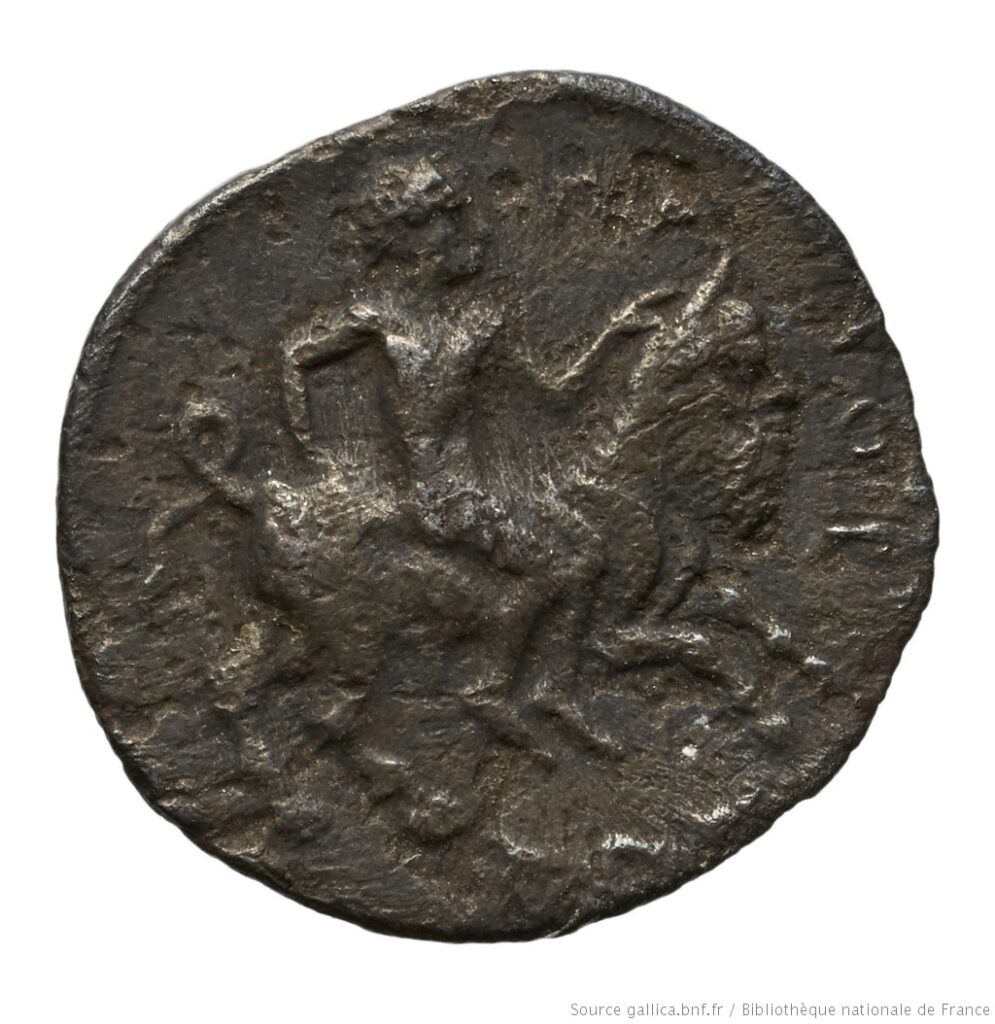
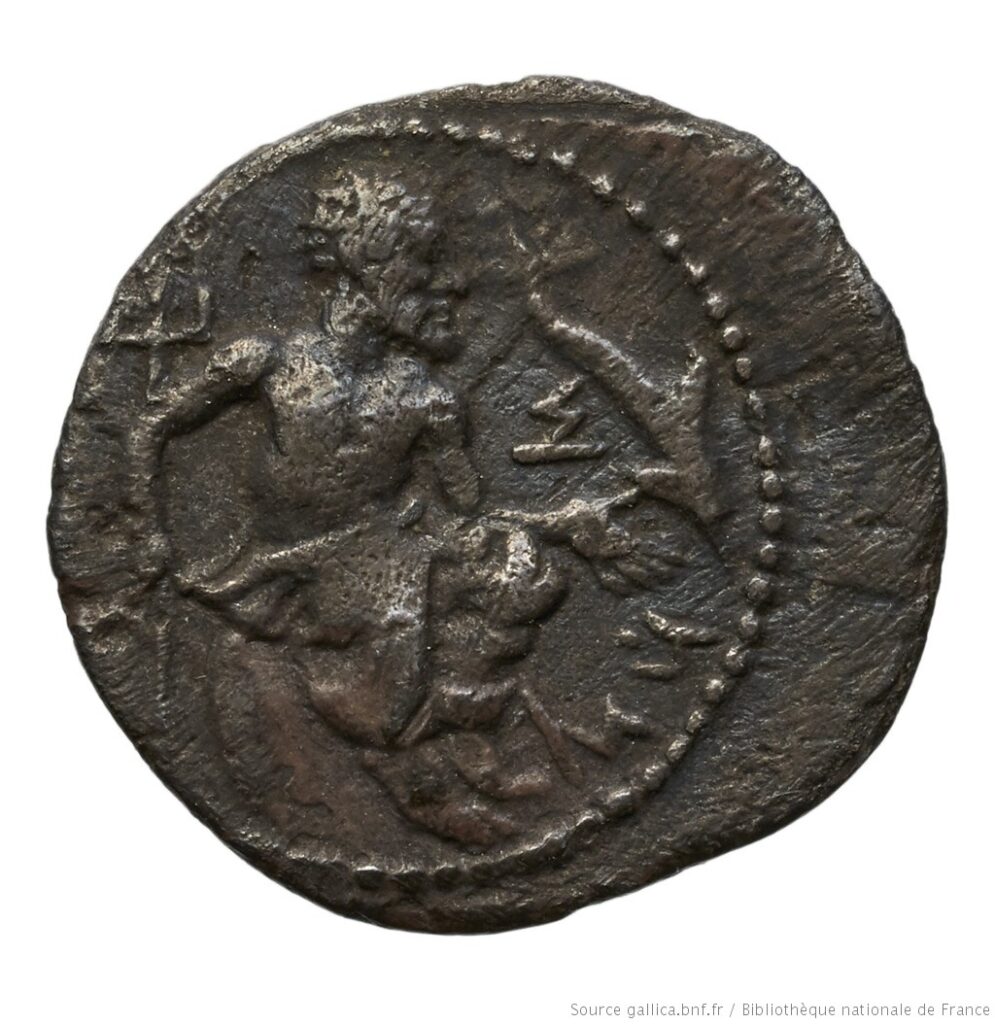
Before interacting with the Greek colonies, Punic colonies do not appear to have been using coins as a form of money starting in the 5th century BCE (Greek Coins, Punic People 313, 315). The first coins that appear tend to have iconography that is very similar to Greek colonies that are minting coins on Sicily, such as Gela, Segesta, and Syracuse (Greek Coins and Their Values Vol 1 92). However, there are elements that are not taken from Greek Iconography such as the man headed bull (Greek Coins, Punic People 316). Elements that are taken are then adapted into Punic Mythology with depictions of Punic gods and goddesses being merged with depictions of Greek gods and goddesses, potentially in order to present their Gods and Goddesses in a manner that is recognizable to the Greek cities that they would be trading with (Greek Coins, Punic People 317-320). An example of this is with the Goddess Tanit, is the Punic Goddess associated with fertility and the harvest among other things (Greek Coins, Punic People 320), who is depicted in the coin below as being associated with Kore/Persephone and in other examples, either directly or via other iconography, such as the Sign of Tanit being near Persephone/Kore (Coins of Punic Sicily. Part 3 12, 32). Some more common iconographic symbols that appear on Punic Sicilian coins are dolphins, which come from Greek iconography and are associated with Tanit (Greek Coins, Punic People 314, 321), and prawns/crayfish (Coins of Punic Sicily Part 1), the quadriga (Coins of Punic Sicily Part 1), which is a four horse chariot, a palm tree (Coins of Punic Sicily Part 1), and an image of a river god standing at an altar (Greek Coins, Punic People 316). The palm tree in particular is a notable indicator of Punic identity as the Greek word for a palm tree, φοῖνιξ, is identical to the Greek word for the Punic people, Phoenician (Coins and their use in the Punic Mediterranean).
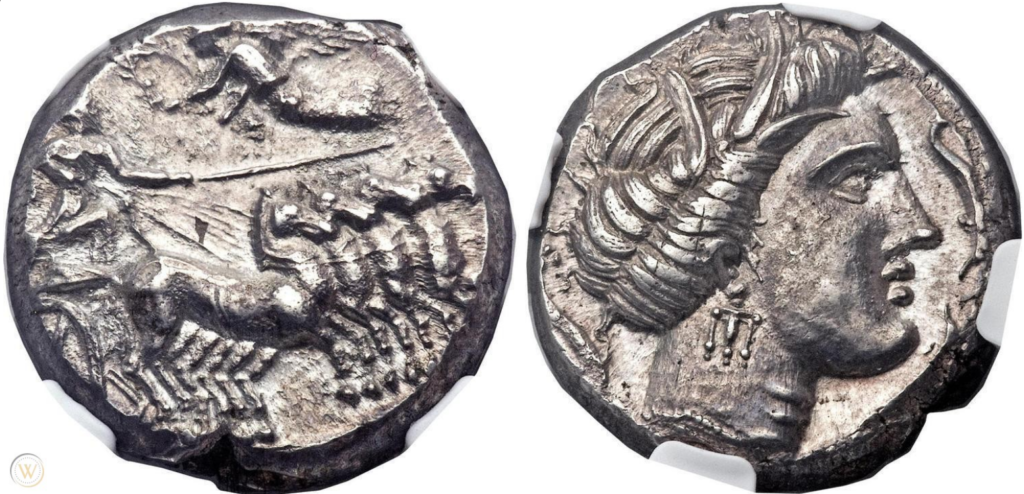
The use of Greek coins makes sense in the context of a state that functions off of trade. You want to use a form of exchange that is accepted by the local people. With this is mind it makes perfect sense as to why Punic Colonies would use Greek coinage standards with regard to weight and iconography (Greek Coins, Punic People 315). However, while some of these coins have Greek lettering and words, others have Punic inscriptions, which as noted by José Miguel Puebla Moron, means that they were probably also used in other contexts beyond just trading. If the coins were only in Greek they probably would just be for trading, the people who need to read it are probably Greek, however by having coins with Punic inscriptions that indicates that at least some coins are being used locally as a form of currency. There is also a single example of a bilingual coin from ~430BCE-405BCE, which has the Greek name PANORMOS on one side and the Punic word SYS on the other (Greek Coins, Punic People 316), which could indicate an understanding of the written Punic language by Greek speakers or just an economical usage of space allowing the coin to function in both spaces showing something to Greek traders on one side and local people on the other.
Carthage Coins
The adoption of coins by Carthage happens roughly 100 years after the adoption of coins (4th Century BCE) by Punic cities in Sicily. The first coins made were for use in Sicily because they are made to a Greek standard of weight and value (Carthaginian Coinage in Perspective). The main material the coins were made of were bronze, gold (Oxford Handbook), and alloy of gold and silver known as electrum (Carthaginian Coinage in Perspective).
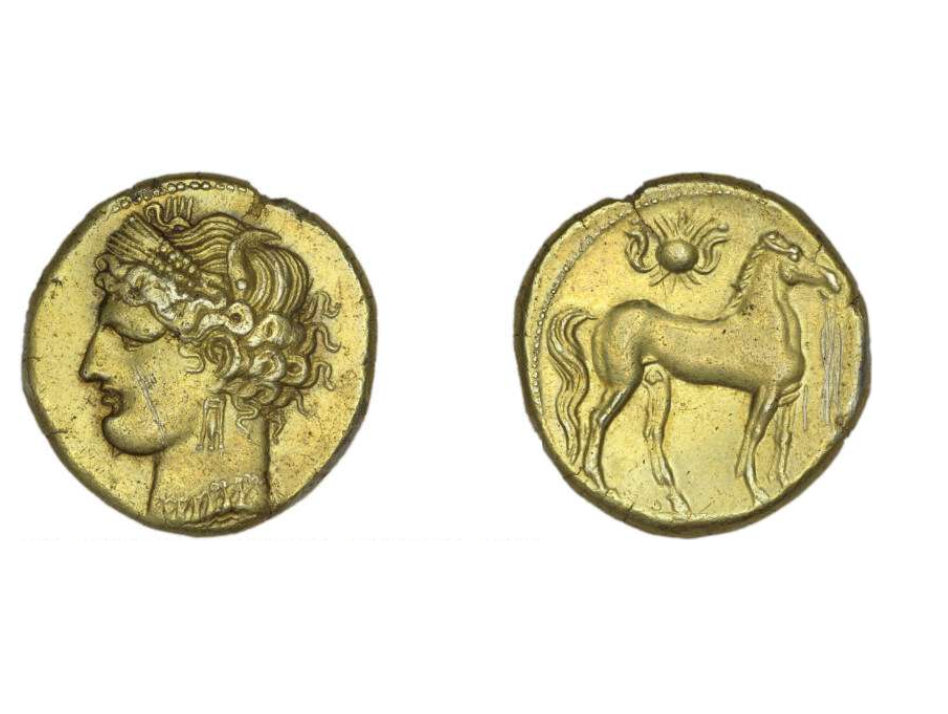
One of the first major uses of coins by the Carthaginians was with gold coins occurring towards the end of the 4th century BCE (Carthaginian Coinage in Perspective). Carthage produced one of the highest known amounts of gold coins, known as Shekels (Coins and their use in the Punic Mediterranean), during this period, most likely to fund its mercenary armies in Sicily (Carthaginian Coinage in Perspective, Britannica Academic, Oxford Handbook). After the 4th century BCE there is a rise in electrum coins and a decline in gold coins though the quantity of coins remains the same until 290 BCE (Carthaginian Coinage in Perspective). The iconography of 4th century coins is similar to Punic Sicilian coins with Persephone, horses, and palm trees appearing (Carthaginian Coinage in Perspective).
During the 3rd century BCE there is an increase in the number of bronze coins produced, with new sizes of coins appear (Carthaginian Coinage in Perspective). One reason for this is probably the first Punic war, which occurs due to conflict between Carthage and Rome over control of Sicily. The production of bronze coins provided a plentiful and cheap form of currency for Carthage to fund their armies. Carthage also produced coins made of silver and electrum during the first Punic war (Carthaginian Coinage in Perspective). Carthage’s coinage remains relatively the same during the second Punic war except most silver and electrum coins that have been found are outside of Carthage, probably due to funding the Carthaginian armies (Carthaginian Coinage in Perspective). After Carthage lost the second Punic war Carthage appears to only have made bronze coins up until the city’s destruction (Carthaginian Coinage in Perspective).
The iconography of Carthaginian coins overall doesn’t change that much from Punic Sicilian Coins. However, what is interesting about this is that there are some examples of regional iconographic images, for example the use of a man-headed bull in Sicily, but there are also examples of a common iconography throughout all of Carthaginian cities, such as the palm tree or horse (Coins and their use in the Punic Mediterranean). This is massively different form the Greek cities states which tended to produce their own unique coins with their own specific iconography, the Owl being a famous symbol for Athens. This indicates that the minting of coins might have been somewhat centralized, however regardless of that it shows that there was a strong presence of a Carthaginian/Punic identity which is shown in how these symbols of that identity are seen in many different areas. If they only appeared in Carthage and its surrounding areas, it would only indicate that that specific area presented itself being Carthaginian. However, these symbols appear in many areas it is indicative of a Carthaginian identity that is not just restricted to the city of Carthage and its surrounding area.
Why does it matter?
While the Punic and Carthaginian use of coins may have potentially started strictly for the purpose of trade with other cities, with them copying iconography from other cities and cultures but they make it their own over time. The use of this iconography is partially to have a visual language that other cities will understand (Coins and their use in the Punic Mediterranean). I would argue that they are making changes and decisions in order to both make their coins understandable to other nations and cities while at the same time representing how they perceive themselves and I do not think those are mutually exclusive ideas.
Conclusion
Coins can tell us a lot about a society and how it presents itself. It can also tell us about certain material conditions that a society has based what types of metal are used in coins and how pure those metals are. The purer a more expensive metal is the more valuable the coin made from it is. However, the way we talk about these coins can also affect the way we perceive them. One trend that I noticed while looking at these coins is that it is a common feature that when a Punic god or goddess appears on a coin that they are referred to just with the Greek equivalent, as much as a god or goddess from one religion can be equivocated with one from another. Tanit is often just referred to as Kore or Persephone or Demeter depending on whoever is writing the piece. Syncretization of gods and goddess from different people was a thing that happened in the ancient Mediterranean and as stated before the Punic and Carthaginian people took inspiration in how they made their iconography on their coins. However, it feels like a disservice to the material evidence that we have of the Punic people to approach it exclusively as an extension and copy in some ways of what the Greeks did. That isn’t to say that we shouldn’t contextualize how Punic and Carthaginian coinage arose due to interactions with Greek cities in Sicily, but that by framing it exclusively in the iconographical language of Greek coins and culture misses the primary lens by which they would have been looked at.
Sources
Bang, Peter F, Scheidel, Walter. The Oxford Handbook of the State in the Ancient Near East and Mediterranean. Oxford: Oxford University Press, 2013.
Britannica Academic, s.v. “Coin,” accessed December 6, 2022, https://academic-eb-com.ezproxy.carleton.edu/levels/collegiate/article/coin/105949.
Britannica Academic, s.v. “North Africa,” accessed December 6, 2022, https://academic-eb-com.ezproxy.carleton.edu/levels/collegiate/article/North-Africa/110707#46460.toc.
Britannica Academic, s.v. “Palermo,” accessed December 6, 2022, https://academic-eb-com.ezproxy.carleton.edu/levels/collegiate/article/Palermo/58089.
Britannica Academic, s.v. “Tanit,” accessed December 6, 2022, https://academic-eb-com.ezproxy.carleton.edu/levels/collegiate/article/Tanit/71184.
Frey-Kupper, Suzanne (2014) Coins and their use in the Punic Mediterranean : case studies from Carthage to Italy from the fourth to the first century BCE. In: Quinn, Josephine Crawley and Vella, Nicholas C., (eds.) The Punic Mediterranean : identities and identification from Phoenician settlement to Roman rule. British School at Rome studies . London: Cambridge University Press, pp. 76-108
Jenkins, G Kenneth. “Coins of Punic Sicily, Part I.” Revue suisse de numismatique 50 (1971): 25–.
Jenkins, G Kenneth. “Coins of Punic Sicily, Part 3.” Revue Suisse de Numismatique 56 (1977): 5–.
Morón, José Miguel Puebla. “Greek Coins, Punic People: An Iconographic Analysis of the Punic Coinage of Sicily.” In Religious Convergence in the Ancient Mediterranean, edited by Sandra Blakely and Billie Jean Collins, 2:313–28. Lockwood Press, 2019. https://doi.org/10.2307/j.ctvd1c9d4.21.
Sear, David R. “SICILY.” In Greek Coins and Their Values Volume 1: Europe, 73–130. Spink Books, 1978. https://doi.org/10.2307/j.ctvm201nt.16.
“Sicilia (Sicily).” In Encyclopedia of Ancient Rome, by Matthew Bunson. 3rd ed. Facts On File, 2012. https://login.ezproxy.carleton.edu/login?url=https://search.credoreference.com/content/entry/fofar/sicilia_sicily/0?institutionId=6659
Visonà, Paolo. “CARTHAGINIAN COINAGE IN PERSPECTIVE.” American Journal of Numismatics (1989-) 10 (1998): 1–27. http://www.jstor.org/stable/43580385.